Version Record launch
When Did That Apple Beta Ship? Meet Version Record
Version Record is an independent, source-backed archive of Apple OS release dates, beta milestones, build numbers, corrections, and historical release patterns.
By Version Record ·
Independent · Source-backed · Public to browse
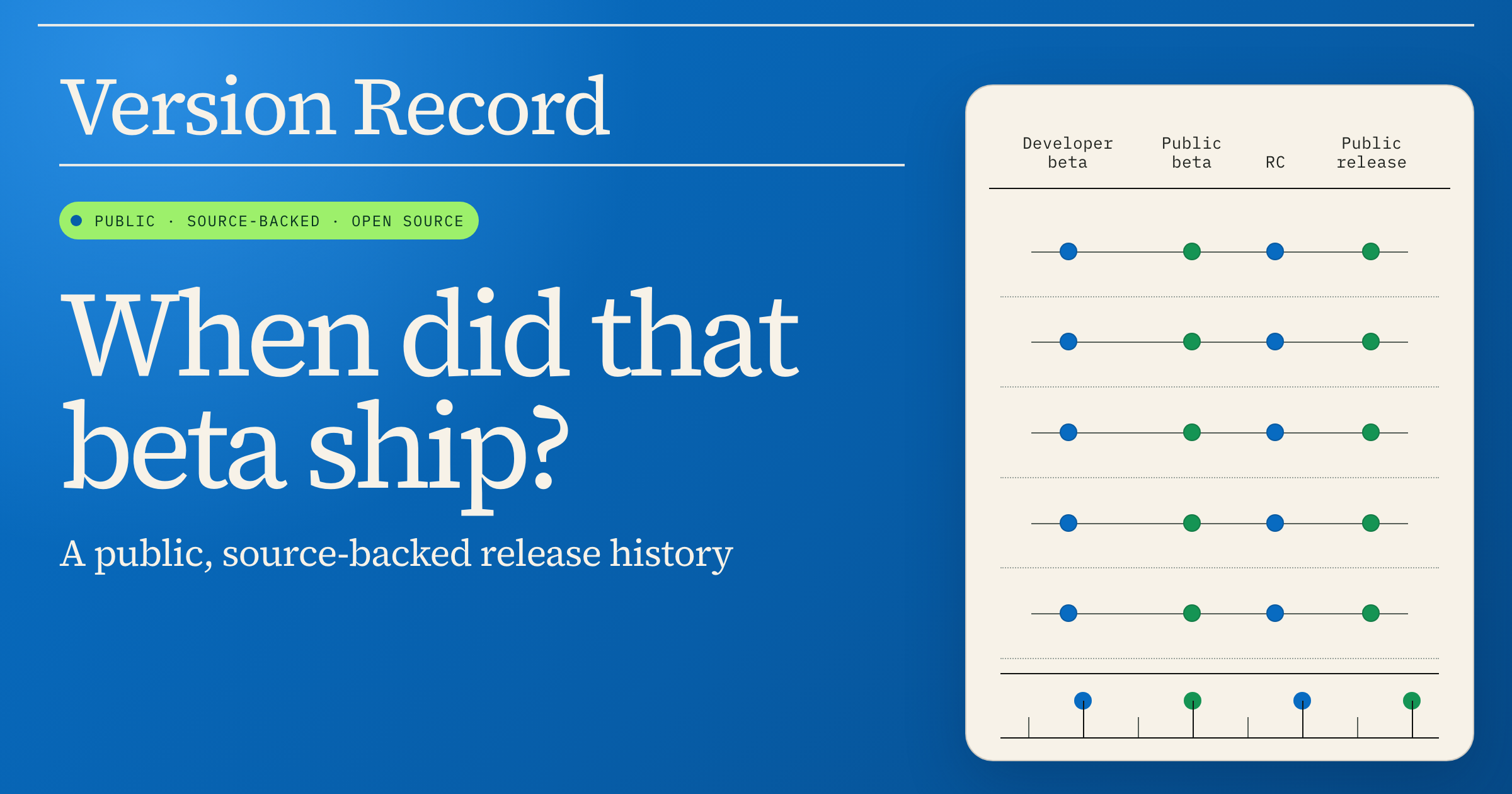
An independent, source-backed archive of Apple OS release dates, beta milestones, builds, and corrections
You know the question: when did that Apple beta actually ship?
Maybe you need the build number from an old developer beta. Maybe you are trying to work out whether the current cycle is moving faster than last year’s. The answer is usually out there, but finding it can mean bouncing between Apple pages, old news stories, forum posts, and archived links.
Version Record exists to make that search less frustrating.
At launch, the archive contains 413 Apple OS versions and 2,071 release events reaching back to 2001. It covers iOS, iPadOS, macOS, watchOS, tvOS, and visionOS, including developer betas, public betas, release candidates, and public releases.
A release history you can check
There are plenty of software timelines online. The hard part is knowing where a date came from and whether it still holds up.
Version Record keeps the release date, build, platform, milestone, and supporting sources together. You can start with the timeline, open a specific record, and follow its citations back to the underlying evidence.
That evidence is usually an Apple Developer release listing or an Apple Support record. Older releases are not always that tidy. Official pages disappear, dates vary by time zone, and two reliable sources can disagree. When an official historical page is unavailable, we may use contemporaneous reporting or archived community material and explain why.
The sources and editorial policy describes how those calls are made. The short version is that we prefer primary sources, avoid filling gaps with guesses, and leave uncertainty visible when the evidence does not support a single clean answer.
How the archive is organized
A version and a release event are not quite the same thing.
One OS version can pass through several developer betas, public betas, release candidates, and a final public release. Each event can have its own date, build number, source, and notes. Version Record connects those pieces without flattening them into one line on a chart.
That structure makes it possible to answer practical questions:
- When did this beta appear?
- Which build went with it?
- How much time passed before the next release?
- How does this cycle compare with an earlier one?
- Has the record changed since it was first published?
The archive currently stays focused on Apple operating systems. It is not trying to catalog every app update, device launch, firmware release, or rumor. That narrower scope gives us room to document the releases we do cover properly.
Corrections stay visible
Historical databases are never finished, and they are never perfect.
A source may surface years later. An archived page may clarify a time-zone discrepancy. A build number that looked settled may turn out to belong to a different milestone. When that happens, silently replacing the old value would make the page look cleaner, but it would also hide part of the record.
Version Record uses a public corrections ledger for material changes. It records what changed, why it changed, and what evidence supports the revision.
If you find a date, label, build, or source that looks wrong, send a correction. Include the release and a supporting link if you have one. Every useful archive gets better when readers can challenge it.
Dates first, forecasts second
The historical record also makes it possible to study Apple’s release cadence.
The forecasts page looks at comparable beta intervals and uses them to estimate plausible windows for future releases. The sample, range, and limitations are shown so you can see what the estimate is based on.
A forecast is not an unpublished Apple schedule, and it should not be read as one. Once the actual release arrives, the confirmed event replaces the estimate in importance. The forecast can then be checked against what really happened.
That is the rule throughout Version Record: establish the dates first, then build analysis on top of them.
Built as a living reference
Version Record is not a snapshot that is finished on launch day.
New releases will be added as they ship. Older records will gain stronger citations when better sources turn up. Corrections will remain visible. Current beta cycles will become historical comparisons for the next one.
That ongoing work is the reason to come back. A release page should become more useful over time, not disappear into an old launch announcement.
The information is public to browse, and the evidence stays attached to the record. The value is in keeping the history current, connected, and understandable.
Independent and unofficial
Version Record is independent. It is not affiliated with, sponsored by, endorsed by, or operated by Apple Inc.
Apple, iOS, iPadOS, macOS, watchOS, tvOS, and visionOS are trademarks of Apple Inc. For official availability, compatibility, and security guidance, consult Apple directly.
Start exploring
If you are looking for a particular beta or build, start with the Apple release timeline. From there, you can inspect the methodology, review the corrections ledger, or compare the latest forecasts.
And if something looks wrong, tell us. A historical record is only useful if people can check it.